
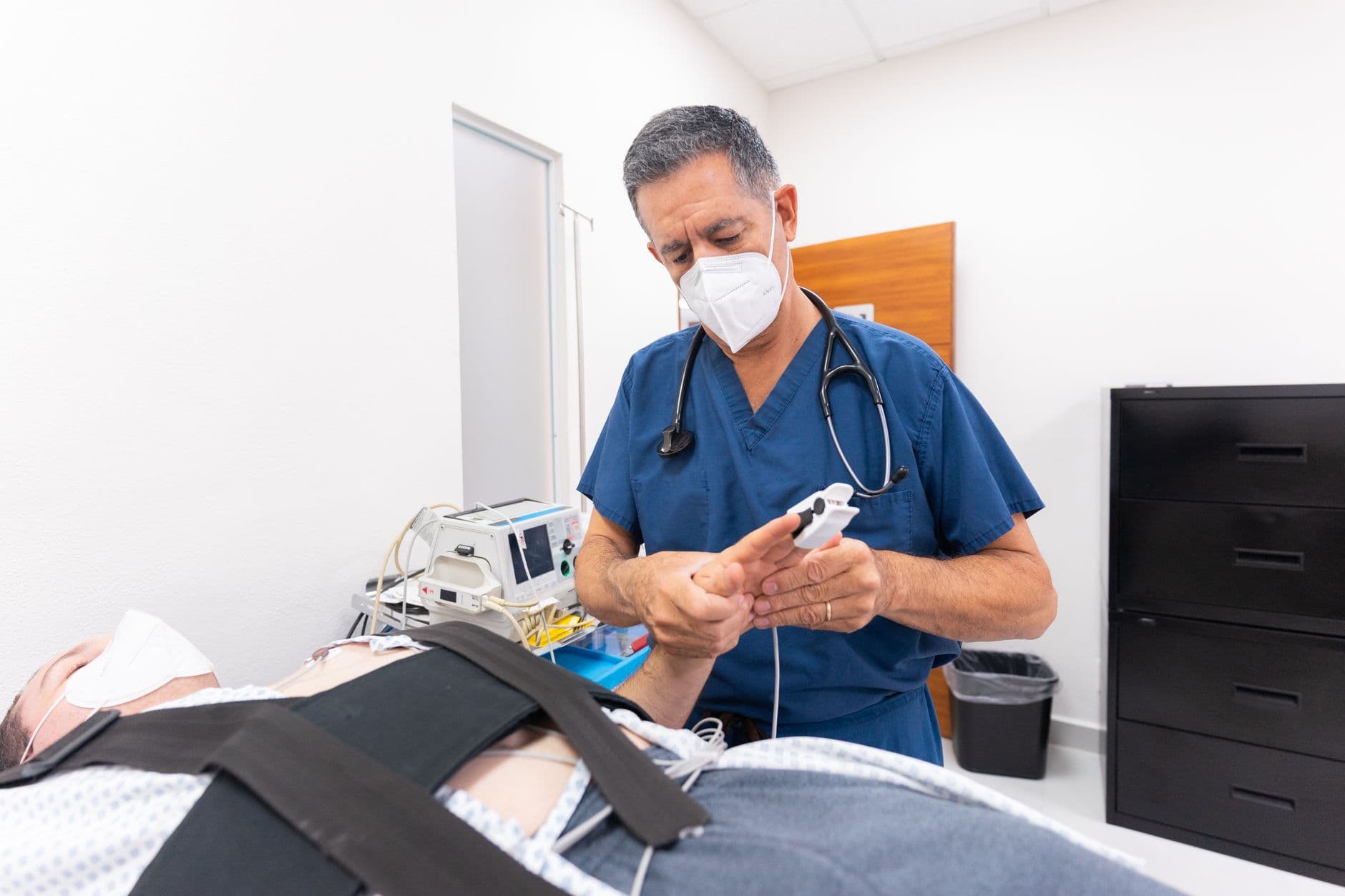
Master SpO2 interpretation. This guide for healthcare professionals covers critical thresholds, error factors, and best practices for reliable measurement in critical care, pulmonology, or at home.
Pulse Oximetry: A Guide to SpO2 Interpretation for Professionals
Pulse oximetry is a non-invasive standard for monitoring oxygen saturation (SpO2). While the measurement seems simple, its clinical interpretation is crucial and complex. This guide is designed for healthcare professionals to master the principles of SpO2, identify critical thresholds, avoid measurement pitfalls, and ensure safe patient care.
What is pulse oximetry and how does it work?
Pulse oximetry is a technique that continuously and non-invasively measures the arterial oxygen saturation of hemoglobin (SpO2), as well as heart rate [S5]. The device, or pulse oximeter, works by spectrophotometry: it emits two lights (red and infrared) through vascularized tissue such as a finger. A sensor then analyzes the difference in absorption of these lights between oxygenated and deoxygenated hemoglobin, which absorb light differently [S2]. The technology isolates the pulsatile signal from arterial blood to provide an accurate measurement. The displayed SpO2 value is the percentage of hemoglobin carrying oxygen. This rapid and continuous assessment of oxygenation has made it an indispensable monitoring standard in anesthesia, critical care, and almost all clinical departments [S3].
Interpreting SpO2 values: beyond the number
An SpO2 value must always be interpreted within the patient's overall clinical context. An isolated reading is insufficient; it must be correlated with medical history and other vital signs to guide medical decisions. A low reading should systematically trigger a clinical evaluation before any intervention.
General norms and alert thresholds
In a healthy individual breathing ambient air, a normal SpO2 is between 95% and 100%. A threshold of 90% is universally recognized as critical, as it corresponds to a partial pressure of oxygen (PaO2) of approximately 60 mmHg. Below this threshold, rapid desaturation can occur, indicating severe hypoxemia that requires immediate medical intervention [S6].
Clinical interpretation table for SpO2
| SpO2 Value (%) | Clinical Interpretation | Suggested Course of Action (to be adapted to context) |
|---|---|---|
| ≥ 95% | Normal saturation for a healthy individual without respiratory pathology | Routine monitoring according to current clinical protocol. |
| 91% - 94% | Mild to moderate hypoxemia. Vigilance zone. | Thorough clinical evaluation (respiratory rate, work of breathing, auscultation), close monitoring, consider oxygen therapy if clinically indicated [S1]. |
| ≤ 90% | Severe hypoxemia. Critical emergency threshold. | Urgent medical intervention: high-flow oxygen administration, aggressive investigation of the underlying cause, preparation for ventilatory assistance if necessary [S6]. |
| < 85% | Very severe hypoxemia. Life-threatening emergency. | Immediate intensive care. Imminent risk of organ failure. |
Factors influencing measurement accuracy: a troubleshooting guide
The reliability of an SpO2 measurement can be compromised by many factors. Healthcare professionals must be aware of them to distinguish true hypoxemia from an artifact, thus avoiding inappropriate interventions or delayed care.
Patient-related factors
- Low peripheral perfusion: Hypotension, hypothermia, vasoconstriction, or a state of shock reduce pulsatile blood flow and make the signal unusable. Action: warm the extremity, try another site (earlobe).
- Movement artifacts: Tremors, shivering, or patient movements are a major cause of erroneous readings. Action: stabilize the limb, wait for a calm period.
- Skin pigmentation: Studies suggest that dark skin pigmentation could sometimes lead to an overestimation of SpO2. Increased clinical vigilance is therefore necessary.
- Severe anemia: The oximeter measures saturation, not the amount of hemoglobin. An anemic patient may have an SpO2 of 100% but suffer from tissue hypoxia due to a lack of oxygen carriers.
- Dyshemoglobinemias: Carbon monoxide poisoning (carboxyhemoglobin) or methemoglobinemia are classic pitfalls. A standard oximeter can display a falsely normal SpO2 despite very severe hypoxia. Diagnosis relies on co-oximetry.
Equipment and environment-related factors
- Nail polish and artificial nails: Dark-colored nail polishes (black, blue) and acrylic nails can absorb light and distort the measurement. Action: remove polish or change site.
- Intense ambient light: Powerful lighting (e.g., surgical light) can saturate the photodetector. Action: cover the sensor with opaque material.
- Sensor positioning: A poorly positioned, too loose, or too tight sensor will result in an incorrect measurement. The emitter and receiver must be perfectly aligned.
Using pulse oximetry in different clinical contexts
Thanks to its versatility, pulse oximetry is a standard diagnostic and monitoring tool in a multitude of clinical scenarios, from emergencies to home monitoring.
- Emergency and critical care departments: Essential triage tool for rapidly identifying respiratory distress and continuously monitoring critical patients [S3].
- Operating room and recovery room: Standard and mandatory monitoring of oxygenation during anesthesia or sedation to detect hypoxia early.
- Pulmonology: Evaluation of patients with chronic respiratory diseases (COPD) and titration of oxygen therapy to achieve saturation targets [S1].
- Pediatrics and neonatology: Crucial monitoring of newborns and children, in whom early detection of hypoxemia is vital to prevent neurological sequelae [S8].
- Home monitoring: Allows self-monitoring of patients on oxygen therapy (sleep apnea, COVID-19), promoting rapid detection of worsening conditions [S2], [S4].
Checklist of best practices for reliable measurement
Obtaining a reliable SpO2 measurement depends as much on the quality of the device as on the rigor of its use. Following a checklist of best practices is the best guarantee of clinical relevance.
- Choose the right sensor: Use an appropriate size (adult, pediatric, neonatal) and place it on a suitable and well-perfused site (finger, earlobe).
- Ensure correct positioning: The sensor should be well-fitted, without being too tight. Check the alignment of the diode and receiver.
- Validate signal quality: Ensure that the plethysmography waveform is stable and regular. A flat or erratic curve indicates an unreliable measurement.
- Correlate heart rate: Compare the oximeter's heart rate with the patient's palpable pulse. A significant discrepancy invalidates the SpO2 measurement [S5].
- Limit movement artifacts: Ask the patient to remain still and stabilize the limb during measurement.
- Prepare the measurement site: Ensure the finger is clean, dry, and warm. Remove any dark-colored nail polish.
- Protect from ambient light: If necessary, cover the sensor to protect it from an intense light source.
Maintenance and regulatory compliance of oximeters
The performance and safety of a pulse oximeter rely on rigorous maintenance and compliance with regulations. Although most devices are self-calibrated, cleaning and disinfection protocols are crucial, especially for reusable sensors. It is imperative to consult the manufacturer's instructions and comply with the Medical Device Regulation (MDR) in force. Good management of medical devices is a pillar of care safety.
Patient and caregiver education: a safety issue
For patients undergoing home monitoring, clear education on oximeter use is a major safety issue. It enables them to use the device correctly, interpret alerts, and react appropriately, thereby strengthening their autonomy [S4].
Key points of this education should include:
- The objective of monitoring and target values defined by the physician.
- The precise method for obtaining a reliable measurement (see checklist).
- The recommended frequency of measurements.
- Recognition of personalized alert thresholds.
- Clear instructions on what to do in case of an abnormal value (e.g., recheck the measurement, contact their doctor or emergency services) [S4].
Frequently Asked Questions
What are the SpO2 thresholds requiring medical intervention?
An SpO2 less than or equal to 90% is a critical threshold that requires urgent medical intervention [S6]. A value between 91% and 94% is a vigilance zone that should prompt a thorough clinical evaluation to prevent deterioration.
How to distinguish low SpO2 due to pathology from a measurement error?
First, assess the patient's clinical status (cyanosis, respiratory distress). Then, methodically check for potential sources of error: sensor position, finger warmth (perfusion), absence of movement, no nail polish, and consistency of the displayed heart rate with the actual pulse.
Is pulse oximetry reliable in patients with dark skin or with painted nails?
No, it is not reliable with dark-colored nail polish, which must be removed. Regarding dark skin, studies point to a risk of SpO2 overestimation. Clinical vigilance is therefore increased: trends must be monitored and the measurement correlated with other vital signs.
What is the role of pulse oximetry in home monitoring of respiratory diseases?
It is an essential tool for monitoring patients on oxygen therapy or with chronic respiratory failure. It allows monitoring treatment effectiveness, detecting decompensation, and guiding oxygen flow adjustment as prescribed, thereby improving patient safety [S1], [S4].
What are the different types of pulse oximeters and their specificities?
The main types are finger oximeters (portable, for spot measurements), handheld oximeters (with wired sensors, for frequent checks or in pediatrics), and multiparameter monitors (used in hospitals for continuous monitoring integrated with other vital signs).
Sources
- [PDF] Oxygénothérapie à domicile - HAShas-sante.fr
- [PDF] Orientations provisoires à l'usage des États Membres sur l'utilisation ... — WHOafro.who.int
- [XLS] Sheet1 - HAShas-sante.fr
- [PDF] RPC VNI Final Argumentaire corrigé - HAShas-sante.fr
- [PDF] Prise en charge clinique des cas de fièvre hémorragique virale - WHOiris.who.int
- [PDF] Prise en charge clinique de la COVID-19 - WHOiris.who.int
- [PDF] Guide opérationnel pour l'audit et la revue de la mortalité ... - WHOiris.who.int
Continue reading
 Incontinence
Incontinence: A Purchasing Guide for Clinics and Pharmacies
A practical guide for clinic and pharmacy buyers. Discover how to choose the right incontinence devices by balancing clinical needs, regulatory compliance, and logistical efficiency to improve care quality.
 Seringue
Syringes: Comparative Guide and Selection Criteria for Healthcare Professionals
The complete guide to choosing the right medical syringe for your needs. Technical comparison (Luer Lock, Luer Slip, 2/3 parts), standards, and advice to optimize your costs and secure your supplies.