
This guide deciphers the MDR regulation, CE marking, and essential standards to help professional buyers secure their medical device purchases and ensure patient safety.
Purchasing compliant medical devices is a major safety and responsibility challenge for any healthcare institution. This practical guide deciphers for you the European MDR (EU) 2017/745 regulation, CE marking, and key standards. The objective: to help you master your purchasing process to secure your supplies and ensure the safety of patients and staff.
Understanding the Medical Device Regulation (MDR): A Strengthened Framework for Patient Safety
The Medical Device Regulation (MDR, or EU 2017/745) is the legal framework governing the marketing and surveillance of medical devices in the European Union [S1]. Having come into force to replace the old directives (93/42/EEC and 90/385/EEC), it strengthens safety, traceability, and transparency by adopting a life-cycle approach to the product.
The Pillars of MDR: Safety, Transparency, and Traceability
Since its application on May 26, 2021, the MDR imposes stricter requirements on manufacturers regarding clinical evidence, conformity assessment, and post-market surveillance (PMS) [S8]. For a buyer, this means a better guarantee of the quality and safety of devices. One of the major innovations is the Unique Device Identification (UDI): this unique code ensures perfect traceability of the product, from its manufacture to its use. It is an essential asset for stock management, materiovigilance, and batch recalls.
CE Marking: Mandatory Passport for Medical Devices in Europe
CE marking certifies that the manufacturer declares their medical device to be compliant with all the safety and performance requirements of the MDR [S3]. It is the mandatory passport for a device to circulate and be used on the European market. Note that it is not a quality label, but an indicator of conformity to the regulation.
The Crucial Role of the Notified Body (NB)
Obtaining CE marking depends on the device's risk class. For Class I (low risk, non-sterile, non-measuring), the manufacturer can self-certify. For all other classes (Is, Im, Ir, IIa, IIb, and III), the intervention of a Notified Body is mandatory. This independent third-party organization, designated by national authorities, audits the manufacturer's technical documentation and quality system. It then issues a CE certificate, which is essential for the manufacturer to affix the marking to their product [S5].
Harmonized Standards and Other Requirements: The Technical Foundation of Conformity
Harmonized standards are technical specifications that give "presumption of conformity" to the MDR. Developed by European organizations (CEN, CENELEC), their application is voluntary but highly recommended. They offer manufacturers a validated method to prove the safety and performance of their products, and buyers a reliable technical benchmark.
To assist you, resources exist. In France, SNITEM (National Syndicate of Medical Technologies Industry) publishes practical guides for applying the regulation [S5]. Similarly, learned societies such as SF2H (French Society for Hospital Hygiene) issue reference recommendations, for example, on the processing of reusable devices to control infectious risk [S2].
Purchasing Process and Due Diligence: Ensuring the Conformity of Your MDs
A rigorous purchasing process is your best tool to ensure the conformity of medical devices. As a buyer, your vigilance is the first line of protection. It is both a regulatory obligation and an ethical responsibility towards patients and healthcare staff.
Key Document Control Points
Before any order, systematically integrate these document control points:
- Require the EU Declaration of Conformity: This document, drafted and signed by the manufacturer, is the act by which they commit their responsibility for the conformity of their product to the MDR.
- Verify the CE Certificate (for classes > I): Request the certificate issued by a Notified Body. Ensure that it is valid and that its scope precisely covers the device(s) you wish to acquire [S5].
- Identify the Notified Body: The name and 4-digit number of the NB must be clearly identified on the certificate and appear next to the CE marking on the product.
Physical Control upon Receipt
Upon delivery, proceed with a systematic physical verification:
- Labeling control: Labeling must be legible and indelible. It must include the CE marking (with the NB number if applicable), the manufacturer's contact details and those of their European authorized representative (if the manufacturer is outside the EU), as well as the Unique Device Identification (UDI) in barcode and alphanumeric code format.
- Instructions for use: The instructions must be complete, clear, and imperatively provided in the official language of the country of use (in French for France).
- Packaging integrity: Check that the packaging guaranteeing sterility (if applicable) is intact.
Post-Purchase Compliance Management: Surveillance and Materiovigilance
Your responsibility does not end with the delivery of the product. To ensure long-term safety, you must ensure rigorous compliance management after purchase, particularly through materiovigilance and traceability.
Materiovigilance and Traceability
The MDR strengthens post-market surveillance (PMS) obligations for manufacturers, and your establishment is an essential link in this chain:
- Internal traceability: Implement systems to record and track devices using their UDI. This is crucial in case of recall or safety incident.
- Incident reporting: Any serious incident involving or potentially involving a medical device must be reported without delay to the manufacturer and the competent authority, the ANSM (National Agency for the Safety of Medicines and Health Products) in France [S6].
For reusable devices, strict adherence to validated cleaning, disinfection, and sterilization protocols is paramount. Resources such as the complete guide to hygiene and disinfection are valuable tools for training teams and maintaining the highest safety standards.
Summary Table of Key Requirements by Medical Device Class
This table summarizes the key regulatory requirements according to the device's risk class, to facilitate your daily checks.
MDR Compliance Matrix by Risk Class
| Risk Class | Risk Level | Conformity Assessment | Key Documents to Verify | Concrete Examples (non-exhaustive) |
|---|---|---|---|---|
| Class I | Low | Self-certification by the manufacturer (except for Is, Im, Ir: NB intervention for specific aspects) | EU Declaration of Conformity | Crutches, bandages, eyeglasses |
| Class IIa | Moderate | Notified Body (NB) required | EU Declaration of Conformity + NB CE Certificate | Syringes, hearing aids, contact lenses |
| Class IIb | High | Notified Body (NB) required (stricter control) | EU Declaration of Conformity + NB CE Certificate | Blood bags, resuscitation ventilators |
| Class III | Very High | Notified Body (NB) required (strictest control) | EU Declaration of Conformity + NB CE Certificate | Breast implants, hip prostheses, coronary stents |
Frequently Asked Questions
What are the main differences between the old MDD and the new MDR regulation?
The MDR strengthens requirements on several key points: it imposes stronger clinical evidence, expands its scope (e.g., colored contact lenses), systematizes post-market surveillance, and makes the Unique Device Identification (UDI) mandatory for complete traceability [S8].
How to verify the validity of a CE certificate for a medical device?
Always demand the EU Declaration of Conformity and, for classes higher than I, the CE certificate from the Notified Body. Check the validity date directly on the certificate. Eventually, the European EUDAMED database will offer a public and centralized verification tool.
What are the responsibilities of a medical device buyer regarding conformity?
Your responsibilities include verifying the device upon receipt (CE marking, UDI, documents), storing it in accordance with the manufacturer's instructions, ensuring its internal traceability, and reporting any serious incident to the ANSM and the manufacturer.
What is a Notified Body and what is its role in MD certification?
It is an independent third-party organization, designated by a national authority, which assesses the conformity of medium to high-risk medical devices before their marketing. It audits the manufacturer and their technical documentation to issue the CE certificate, which attests to conformity with the MDR.
What are the risks incurred when purchasing non-compliant medical devices?
The risks are major: endangering patients and staff, legal and financial penalties for your establishment, damage to your reputation, and operational losses related to the mandatory withdrawal of non-compliant products.
Sources
- RÈGLEMENT (UE) 2017/ 745 DU PARLEMENT EUROPÉEN ET DU CONSEILeur-lex.europa.eu
- Synthèse des obligations règlementaires selon le MDR 2017/745 et l'IVDR 2017/746rumb.fr
- Marquage CE: obtenir le certificat, exigences de l'UE - Your Europeeuropa.eu
- FICHE PRATIQUE CONFORMITE REGLEMENTAIRE DES DISPOSITIFS MEDICAUX ET REDACTION DES DOCUMENTS DE LA CONSULTATIONsnitem.fr
- Guide de bonnes pratiques de traitement des dispositifs médicaux réutilisablessf2h.net
- Comment la réglementation concernant l'évaluation des dispositifs médicaux a-t-elle évolué avec l'arrivée du règlement 2017/745 ?dumas.ccsd.cnrs.fr
Continue reading

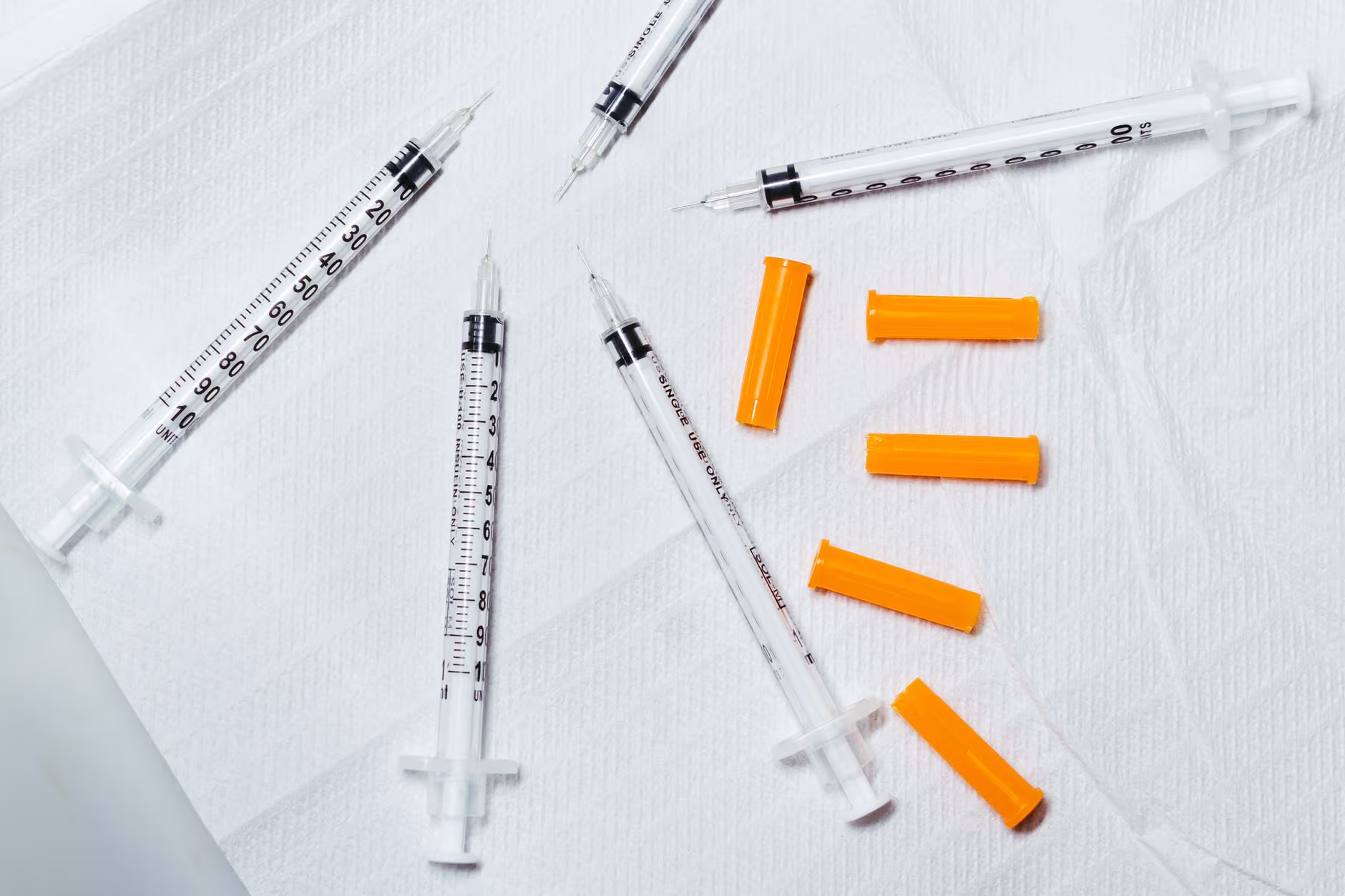 Seringue
Syringes: Comparative Guide and Selection Criteria for Healthcare Professionals
The complete guide to choosing the right medical syringe for your needs. Technical comparison (Luer Lock, Luer Slip, 2/3 parts), standards, and advice to optimize your costs and secure your supplies.
 Matériovigilance
ANSM Materiovigilance: Incident Reporting and Recall Management Guide
Materiovigilance is the surveillance of medical devices after they are placed on the market. For professionals and distributors, knowing how to report an incident to the ANSM and manage a product recall is not an option: it is a crucial legal obligation for patient safety.